

Opis
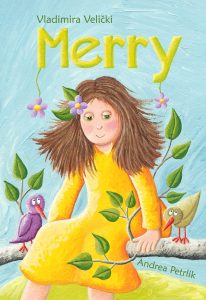
The authorial picture book “Merry”, by Vladimira Velički and Andrea Petrlik, addresses the issues of difference, otherness, and being different, and shows a path toward acceptance – something much needed in today’s world. The story is characterized by a fairy-tale quality, guiding children toward goodness and pointing them to ways of solving problems.
Like every quality picture book, this one has a single story but two narrators. The textual narrative, tells the story of a girl who, when she was born, was named Merry. However, she could not pronounce the letter R, so people began calling her Melly (“Melancholy”). And she truly was melancholic, even sad, as there was no peace in her home.
The story further explores troubled family relationships, Merry’s heightened sensitivity to sounds and the atmosphere of conflict, her departure from home, and her entry into a fairy-tale world.
The fairy-tale elements are introduced gradually and unobtrusively, making it easier to arrive at a resolution and revealing a path of kindness and helping others, which ultimately strengthens Melly and leads her back home.
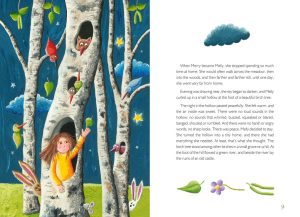
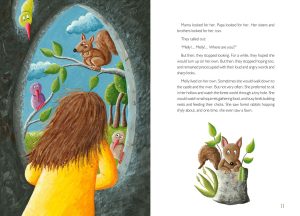
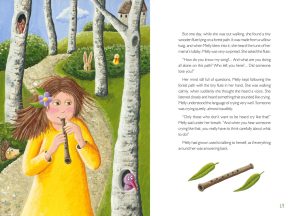
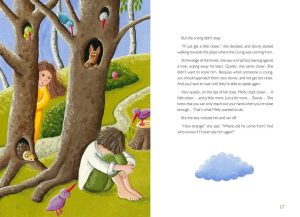
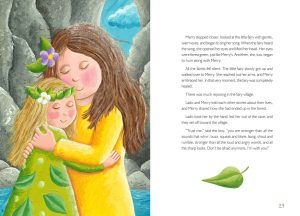
The illustrator adds her own interpretation to the text, enriching it with imaginative and high-quality illustrations that tell another story – about a house filled with conflict, sadness, and unrest; the secrets of a birch forest; an underground cave lake; birds and other forest animals; and much more. For this reason, the picture book invites rereading, discovery, and conversation, encouraging dialogic reading and storytelling.
The message of the picture book is very clear – sometimes we are alone, we can and may be different, and struggles in life are inevitable. However, if we do not give up, if we continue to see the good and help others, we will grow stronger and be able to overcome difficulties.The themes of family relationships and diversity are contemporary and necessary in children’s literature. What should be emphasized is that in this picture book, the theme does not overshadow the poetic and visual language. It is written and illustrated with great skill; there is no place for pathos, nor for direct moralizing, which is often the case in problem-oriented picture books. In this story, it is words, metaphors, a refined and sensitive language and style, along with illustrations, that heal and complement each other in a deeply nuanced way.
Written by Vladimira Velički, illustrated by Andrea Petrlik